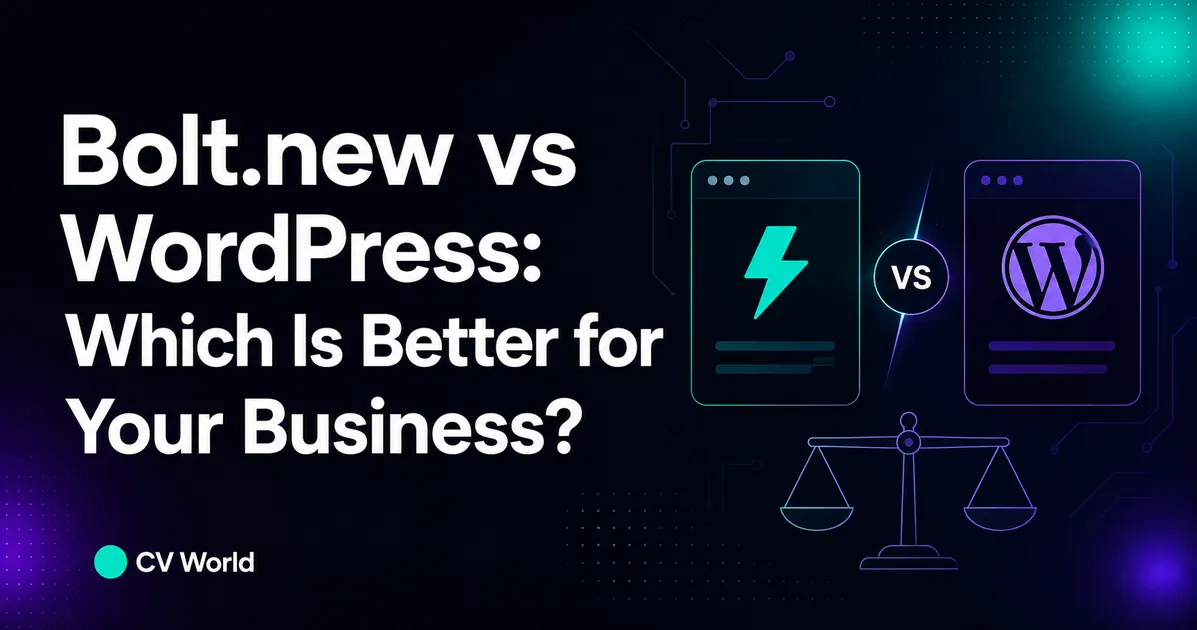
WordPress is significantly better than Bolt.new for commercial business websites that depend on organic Google search rankings, regular content publishing, non-technical marketing management, and multi-year data ownership. Bolt.new is superior for technical founders and developers who need to rapidly prototype in-browser fullstack React applications, SaaS MVPs, and complex JavaScript web apps before writing backend production infrastructure.
Key Takeaways
- Bolt.new is an AI-powered browser coding sandbox for developers; WordPress is an enterprise content management system.
- WordPress powers over 43% of the internet and provides complete SEO control with Rank Math and JSON-LD schema.
- Bolt.new applications require ongoing developer intervention for everyday content updates, copywriting, and media swaps.
- WordPress paired with Elementor Pro provides visual drag-and-drop editing with zero recurring AI token expenses.
- A hybrid model is often optimal: prototype app logic in Bolt.new and host your commercial website and blog on WordPress.
Strategic Overview: In-Browser AI Sandbox vs Production Enterprise CMS
When launching a new digital venture, choosing the right platform foundation directly determines your development speed, operating expenses, and long-term search visibility. The rise of generative AI has created powerful new tools like Bolt.new, an AI-first web development agent capable of scaffolding complete full-stack React and Node applications from natural language prompts. Meanwhile, WordPress remains the world’s most dominant content management system, powering over 500 million websites globally.
Comparing Bolt.new to WordPress is not a question of which tool is technically superior in a vacuum, but rather which tool aligns with your specific business goals. If your priority is publishing marketing content, ranking on search engines, and generating inbound leads without writing code, WordPress is the definitive choice. If your goal is prototyping an interactive software dashboard, SaaS product, or browser tool, Bolt.new offers unprecedented speed.
Feature & Capability Comparison: Bolt.new vs WordPress
| Feature / Capability | Bolt.new (AI App Engine) | WordPress (Self-Hosted + Elementor) | Winner |
|---|---|---|---|
| Target Audience | Software developers & technical founders | Businesses, marketers, agencies & creators | Context Dependent |
| Content Management & Blogging | None (requires hardcoding in JSX/TSX) | Native CMS with categories, authors & revisions | WordPress |
| SEO & Schema Control | Manual meta tags in React Helmet/Head | Automated XML sitemaps, Rank Math & Schema | WordPress |
| E-Commerce Capabilities | Custom Stripe integration via Node backend | Full WooCommerce ecosystem (taxes, shipping, UPI) | WordPress |
| Web App Prototyping | Instant in-browser fullstack scaffolding | Requires custom plugins or headless React config | Bolt.new |
| Ongoing Maintenance Cost | Ongoing AI token usage & developer retainer | Flat affordable hosting (Hostinger/WPX) | WordPress |
SEO & Organic Traffic: Why WordPress Outperforms Bolt.new Prototypes
Search engine optimization (SEO) is the primary customer acquisition channel for modern businesses. Achieving top rankings on Google requires rigorous technical standards: clean semantic HTML5 markup, automated XML sitemaps, Open Graph social tags, structured JSON-LD schema (FAQPage, Article, LocalBusiness), and optimized Core Web Vitals scores.
In Bolt.new, every SEO optimization must be hand-coded into React routing files and custom meta components. Single-page client-rendered React apps often struggle with search crawler indexing, as bots may fail to execute JavaScript bundles fully. In contrast, WordPress generates pristine server-side HTML out of the box. Combined with leading SEO suites like Rank Math, WordPress automates 301 redirect management, canonical URL tags, internal linking suggestions, and instant indexing via IndexNow.
Client Handoff & Marketing Team Autonomy
For marketing leaders and agency owners, the most significant risk of deploying a Bolt.new website is developer bottlenecking. If your marketing coordinator needs to update a product price, publish a customer case study, or swap a banner image for a holiday promotion, a Bolt.new site requires opening a Git repository, editing TypeScript files, and running a CI/CD build pipeline. With WordPress and Elementor Pro, marketing team members can make instant visual edits in a WYSIWYG editor without touching code or risking site downtime.
Frequently Asked Questions
Ready to Build Professional Websites Faster?
Supercharge your WordPress design workflow with 100+ premium widgets, theme builder capabilities, and dynamic WooCommerce templates.
No. Bolt.new applications require Node.js runtime environments or modern edge hosting platforms (like Vercel, Netlify, or Cloudflare Pages) to execute serverless functions and build Vite bundles.
Both platforms can be exceptionally secure when properly configured. WordPress benefits from 20+ years of enterprise security hardening, automated patch cycles, and robust Web Application Firewalls (Wordfence, Cloudflare).
Yes! This is one of the most effective modern workflows. Use Bolt.new as an AI design ideation engine, then migrate the design tokens into Elementor Pro for long-term maintainability.
WordPress is significantly cheaper for commercial sites. Affordable high-speed hosting (such as Hostinger at ₹139/mo) and an Elementor license avoid the steep developer maintenance costs associated with custom React web apps.